
ENTERPRISE MICROSOFT ENGINEERING & MIGRATION
ASP.NET Core & C# Development Services
High-Throughput .NET Engineering & Modernization — Pentatomic Solutions architects, builds, and modernizes mission-critical enterprise systems using ASP.NET Core, C#, and cloud-native microservices. We transition legacy .NET Framework monoliths into containerized, sub-120ms p99 APIs with zero data loss and measured business continuity.
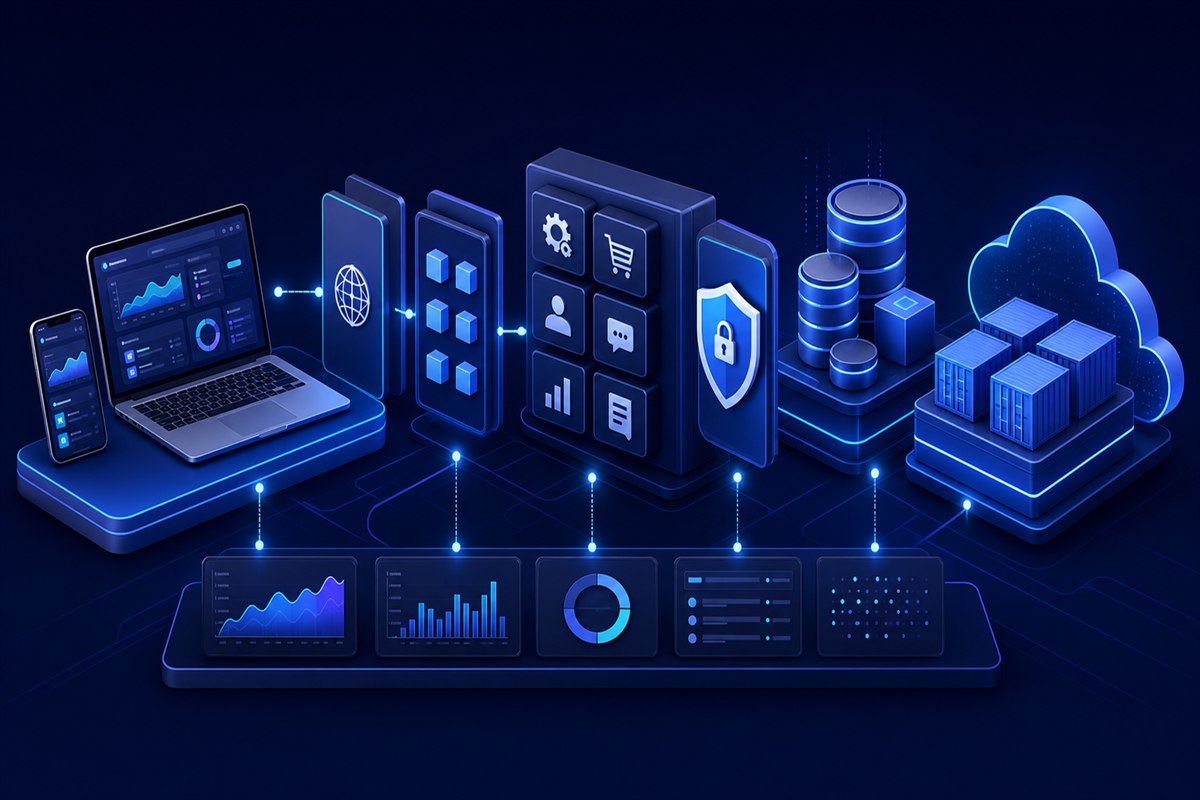
What Are Enterprise .NET Development & Modernization Services?
Direct Answer: Enterprise .NET development services encompass architecture design, custom C# API engineering, performance optimization, and incremental migration from legacy .NET Framework (4.5–4.8) to modern cross-platform .NET 8/9. Utilizing ASP.NET Core, Entity Framework Core, and cloud-native containerization, Pentatomic Solutions refactors monolithic Windows-hosted applications into scalable Linux microservices, achieving sub-120ms p99 latency and up to 40% reduction in cloud compute expenditures.
| Architecture Vector | Legacy .NET Framework (4.0 – 4.8) | Modern ASP.NET Core (.NET 8 / 9) |
|---|---|---|
| Process Model | Monolithic IIS Worker (w3wp.exe), Windows OS locked | Lightweight Kestrel reverse proxy, multi-platform Linux/Docker |
| Memory Footprint | 800MB – 2GB+ per idle app pool instance | 80MB – 180MB per microservice container |
| Throughput & Concurrency | Blocking threads, vulnerable to sync-over-async pool starvation | Full non-blocking async state machines, epoll/kqueue IO pipelines |
| Database Access | Classic EF6 with heavy change tracking and slow query generation | EF Core with compiled queries, AsNoTracking(), and keyset pagination |
| Deployment Target | Manual MSI / Web Deploy to Windows Server VMs | Automated CI/CD container builds to AWS ECS, EKS, or Azure App Service |
De-risking Legacy Upgrades: The Strangler Fig Architecture
The most catastrophic error in enterprise software modernization is the “big-bang rewrite.” Attempting to rewrite a decade-old .NET Framework system from scratch freezes feature delivery for 18–24 months, obscures subtle legacy business rules, and introduces massive cutover risk.
Pentatomic Solutions utilizes the Strangler Fig Pattern endorsed by the Microsoft Cloud Architecture Center. We introduce a high-performance API gateway using YARP (Yet Another Reverse Proxy) or AWS Application Load Balancers directly in front of the legacy IIS application:
1. Edge Routing & Telemetry
YARP sits at the boundary, inspecting incoming HTTP requests. Un-migrated routes pass straight through to the legacy IIS cluster, while newly refactored endpoints route transparently to modern ASP.NET Core services.
2. Authentication Bridge
We bridge legacy ASP.NET Forms Authentication or WCF tokens with modern OAuth2 / OpenID Connect JWT tokens using shared data protection keys, enabling seamless single sign-on across hybrid runtimes.
3. Sliced Domain Extraction
We decouple high-churn, business-critical sub-domains (e.g. payment processing, order dispatch) into independent C# microservices backed by clean domain-driven boundaries and contract-first OpenAPI schemas.
4. Eventual Consistency via Outbox Pattern
Where legacy databases must synchronize with newly isolated databases, we implement the Transactional Outbox Pattern via MassTransit and Amazon SQS/RabbitMQ to eliminate distributed 2-phase locks.
High-Throughput Performance Engineering: Kestrel & EF Core
Upgrading to .NET 8/9 is not just a framework bump; it requires eliminating architectural performance anti-patterns that throttle database throughput and saturate thread pools.
1. Eliminating Thread-Pool Starvation
In high-concurrency environments, calling .Result or .GetAwaiter().GetResult() on asynchronous tasks blocks Kestrel worker threads. Under a burst of 1,000 concurrent requests, the .NET thread-pool injector cannot spawn new threads fast enough, triggering severe request timeouts and 504 Gateway errors. Our engineering team strictly enforces end-to-end async/await propagation with deterministic CancellationToken forwarding across all HTTP, database, and Redis RPC layers.
2. Entity Framework Core Query Discipline
Entity Framework provides enormous developer velocity, but careless usage leads to the notorious N+1 query trap and runaway memory bloat. We enforce strict query standards in compliance with Microsoft ASP.NET Core Performance Best Practices:
- Read-Path Projection: Read operations always execute with
.AsNoTracking()and explicit.Select(dto => new {...})projections, avoiding loading full entity tracking graphs into memory. - Keyset Pagination: We replace offset-based pagination (
Skip(10000).Take(50)which forces full table index scans) with keyset/cursor pagination (WHERE (CreatedAt, Id) < (@CursorDate, @CursorId) LIMIT 50). - Single Round-Trip Joins: We use explicit split queries (
.AsSplitQuery()) where relational Cartesian explosions threaten database performance, ensuring zero unnecessary locking.
Complementary Cloud & Enterprise Engineering Solutions
Enterprise .NET engineering rarely exists in isolation. Pentatomic Solutions integrates your core Microsoft backend with modern cloud ecosystems, dedicated teams, and automation pipelines:
Cloud Application Engineering
Package .NET microservices into minimal Docker containers deployed on AWS ECS Fargate, Kubernetes (EKS), or Azure Container Apps with automated zero-downtime rolling deploys.
Multi-Tenant SaaS Development
Architect robust multi-tenant data isolation (tenant-per-database or shared schema with row-level security) and granular role-based access control (RBAC) in ASP.NET Core.
Dedicated Senior Engineering Teams
Augment your in-house engineering capacity with battle-tested senior C# developers, solution architects, and cloud DevOps specialists working directly within your sprint cadence.
Enterprise AI & NLU Integration
Connect your .NET business APIs with Semantic Kernel and private LLM pipelines to automate invoice processing, document validation, and conversational intelligence.
Enterprise .NET Development: Frequently Asked Questions
How do you modernize a legacy .NET Framework application without a full rewrite?
We deploy the Strangler Fig architecture using YARP (Yet Another Reverse Proxy) or AWS ALB at the network edge. Legacy IIS and new ASP.NET Core runtimes operate concurrently. High-value endpoints are incrementally extracted and rewritten in modern .NET 8/9, de-risking the migration and delivering continuous business value without downtime.
What performance gains can we expect by migrating from .NET Framework to .NET 8 or 9?
Enterprise applications typically see a 50–70% reduction in CPU consumption, 60%+ decrease in memory allocation, and sub-120ms p99 response times. Cross-platform Linux containerization on AWS Graviton or Azure ARM instances also reduces cloud hosting infrastructure bills by up to 40%.
How do you prevent thread-pool starvation and concurrency deadlocks in ASP.NET Core?
We enforce strict asynchronous programming hygiene across all layers: zero blocking calls (avoiding .Result or .Wait()), complete propagation of CancellationToken parameters, proper connection pool sizing for SQL Server and Redis, and non-blocking I/O pipelines.
Can our existing in-house development team collaborate directly with your engineers?
Yes. We operate transparently within your Jira/GitHub/Azure DevOps environments. We pair with your internal teams, establish clean coding standards, conduct peer code reviews, and provide comprehensive architectural documentation for full handover.
Modernize Your Enterprise .NET Architecture
Discuss your existing legacy codebase, runtime performance bottlenecks, or upcoming product roadmap with our senior systems architects.