
ENTERPRISE ARTIFICIAL INTELLIGENCE & WORKFLOW AUTOMATION
Enterprise AI and Automation Solutions
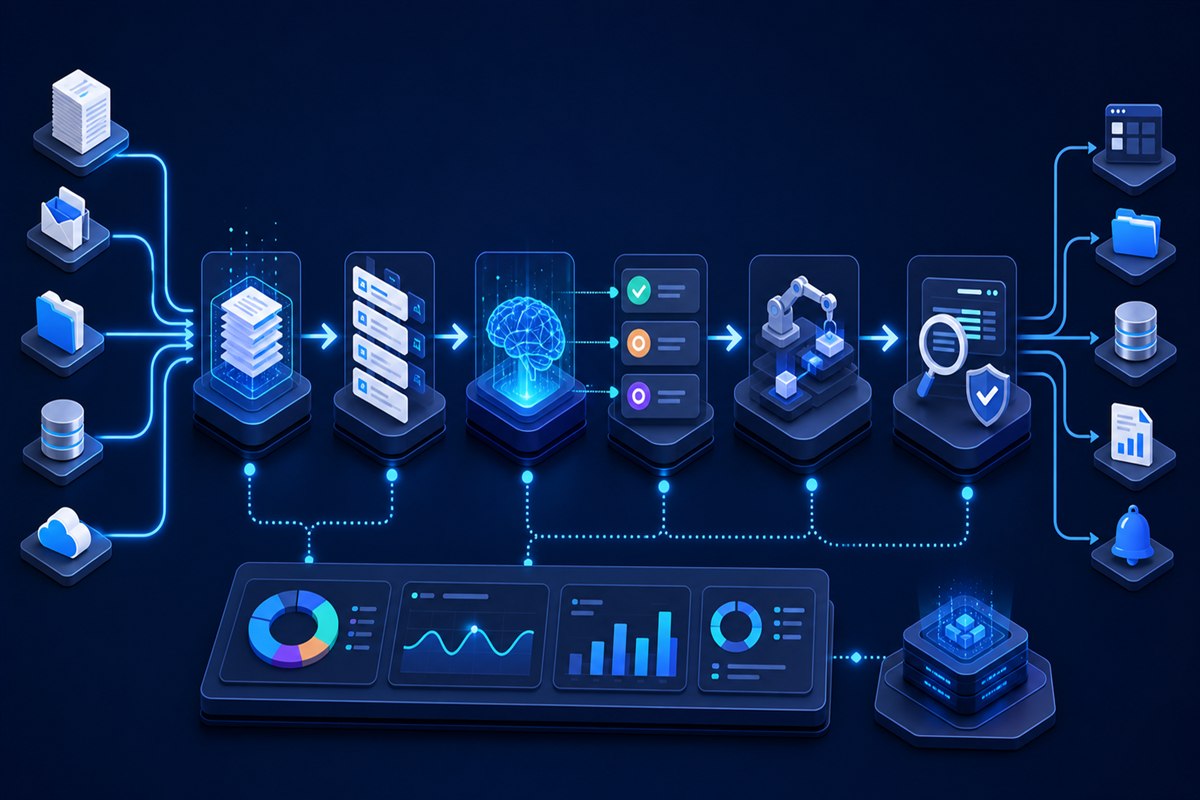
Deterministic AI Engineering & Intelligent Systems Integration — Pentatomic Solutions connects private Large Language Models (LLMs), retrieval-augmented generation (RAG), and event-driven automation directly into core enterprise applications. We replace manual repetitive data processing with auditable, high-throughput AI pipelines that respect data boundaries, latency ceilings, and human-in-the-loop oversight.
What Are Enterprise AI and Automation Solutions?
Direct Answer: Enterprise AI and automation solutions combine specialized machine learning models, private Large Language Models (LLMs), and deterministic workflow orchestration to automate data-intensive business operations. Unlike consumer chatbots, production enterprise AI incorporates structured JSON tool calling, Retrieval-Augmented Generation (RAG), strict prompt-injection defenses aligned with NIST AI Risk Management Framework standards, and human-in-the-loop audit trails, reducing operational turnaround times by 60% to 85% while maintaining zero data exfiltration.
| Architecture Vector | Experimental “Wrapper” Prototype | Production Enterprise AI Pipeline |
|---|---|---|
| Output Contract | Unconstrained natural language text; prone to parsing failures | Strict typed JSON Schema validation with programmatic retry loops |
| Data Grounding | Whole-document prompt stuffing; high token costs and lost context | Hybrid vector + BM25 reciprocal rank fusion (RRF) with exact citations |
| Security & Privacy | Unfiltered user input passed directly to public third-party APIs | Pre-flight Presidio PII scrubbing and OWASP LLM prompt injection defenses |
| Failure Behavior | Silent hallucinations or uncaught 500 error timeouts | Fast-failing circuit breakers, fallback heuristics, and human escalation queues |
| Telemetry & Cost | Zero visibility into per-request inference expenses | OpenTelemetry trace instrumentation tracking token count and model latency |
Deterministic Tool-Calling Architecture & Zero-Hallucination Guarantees
The primary obstacle to operationalizing Generative AI in business is nondeterminism. When an LLM generates free-form markdown, downstream transactional software cannot reliably parse the output. A missing bracket or hallucinated date invalidates database inserts and halts automated pipelines.
Pentatomic Solutions solves this through Deterministic Tool-Calling Architecture:
1. Schema-Enforced Grammars
We bind model completions to strict JSON Schemas (via OpenAI Structured Outputs, Anthropic Tool Use, or Gemini Controlled Generation). The engine restricts token decoding at the logits level, guaranteeing mathematically valid JSON payloads that deserialize directly into strongly typed C# or TypeScript DTOs.
2. Function Calling Boundaries
The AI model acts as a reasoning engine rather than a direct database manipulator. When the model determines an action is needed (e.g. reschedule_booking(booking_id, new_date)), it emits an intent payload that our backend validates against authentication rules before executing the database write.
3. Hallucination Guardrails & Confidence Thresholds
We inject citation verification filters. If the model cannot ground an extracted answer in the supplied source document with $\ge 0.85$ confidence, it is prohibited from guessing; the workflow routes the transaction to a human specialist with source highlights.
4. Pre-Flight PII Redaction
Customer data never exits your compliance perimeter raw. In compliance with OWASP Top 10 for LLM Applications, an inline sanitization layer scrubs credit cards, social security numbers, and private medical data before invoking external model endpoints.
High-Precision Retrieval-Augmented Generation (RAG)
Effective enterprise AI requires grounding models in your actual operational data — ERP tables, knowledge bases, contract PDFs, and support histories. Naive RAG setups (simply slicing text every 500 characters and querying a vector database) fail in production because they shatter semantic context across chunk boundaries.
Engineering Precision Retrieval
Our production RAG implementations incorporate state-of-the-art information retrieval engineering:
- Hierarchical Document Chunking: Rather than arbitrary character slicing, we parse documents by abstract syntax trees (ASTs), markdown headers, and structural document sections. Parent-child chunk linking ensures the retrieval engine surfaces the exact paragraph while providing the surrounding chapter context to the LLM.
- Hybrid Reciprocal Rank Fusion (RRF): Dense vector embeddings excel at broad conceptual matching, but struggle with exact alphanumeric strings (part numbers, invoice codes, case IDs). We combine dense embeddings (Pinecone, Qdrant, pgvector) with BM25 sparse keyword indices to achieve 99%+ retrieval accuracy.
- Reranking Pipelines: Retrieved candidate chunks pass through a cross-encoder reranker (Cohere Rerank or BGE-Reranker) before prompt assembly, pruning irrelevant fragments and keeping context windows concise.
Integrated Enterprise Automation Synergies
True automation scales when intelligent agents connect with existing enterprise platforms, telecommunications, and custom backends:
Amazon Connect Conversational AI
Deploy Amazon Lex V2 bots and generative agent-assist workflows that listen to live calls, transcribe dialogue in real time, and suggest validated resolutions instantly.
High-Throughput .NET Backends
Orchestrate complex AI agent loops using Semantic Kernel, ASP.NET Core, and distributed background workers capable of processing millions of automated events daily.
Operational Web Applications
Provide enterprise operators with responsive, real-time React dashboards for review queues, document diffing, and manual override controls.
Cloud-Native Serverless Pipelines
Run asynchronous document ingestion, OCR, and model inference on AWS Lambda, Amazon SQS, and Step Functions with automatic cost-optimized auto-scaling.
Enterprise AI Automation: Frequently Asked Questions
How do you prevent Large Language Models from hallucinating in business workflows?
We combine three engineering layers: (1) Schema-enforced grammars that force outputs into strict, validated JSON contracts; (2) Retrieval-Augmented Generation (RAG) that restricts answers strictly to verified source documents; and (3) Automated citation verification that halts execution and flags human reviewers if confidence thresholds are not met.
Will our proprietary enterprise data be used to train public AI models?
No. We exclusively deploy enterprise-tier API agreements (OpenAI Enterprise, AWS Bedrock, Azure OpenAI Service) or self-hosted open-weights models (Llama 3, Mistral) within your isolated VPC where terms explicitly legally prohibit using customer inputs for model training.
What is the difference between deterministic automation and generative AI?
Deterministic automation (rules, webhooks, regex, SQL workflows) executes identically 100% of the time with zero variance; it is best for calculations, accounting, and state transitions. Generative AI excels at unstructured input understanding, text extraction, language translation, and intent classification. We combine both: AI extracts intent and parameters, while deterministic code executes the transactional action.
How do you monitor and control monthly token costs for production AI pipelines?
We implement OpenTelemetry tracing across all model calls, logging prompt tokens, completion tokens, model IDs, and tenant IDs. We enforce per-request token caps, utilize semantic vector caching to avoid re-generating answers for identical questions, and apply automated budget circuit breakers.
Turn Operational Overhead into Automated Velocity
Discuss your manual workflows, document processing bottlenecks, or conversational automation goals with our senior engineering architects.