
PENTATOMIC SOLUTIONS · SERVICES
Cloud Application Development
cloud application development services — Pentatomic Solutions provides cloud application development services for businesses that need resilient platforms, controlled scaling and faster delivery without losing architectural clarity. We design new AWS applications and improve existing systems moving toward cloud-native operation.
Our engineers connect application design with security, deployment, observability and cost awareness so a cloud move produces an operable system rather than a collection of unmanaged services.
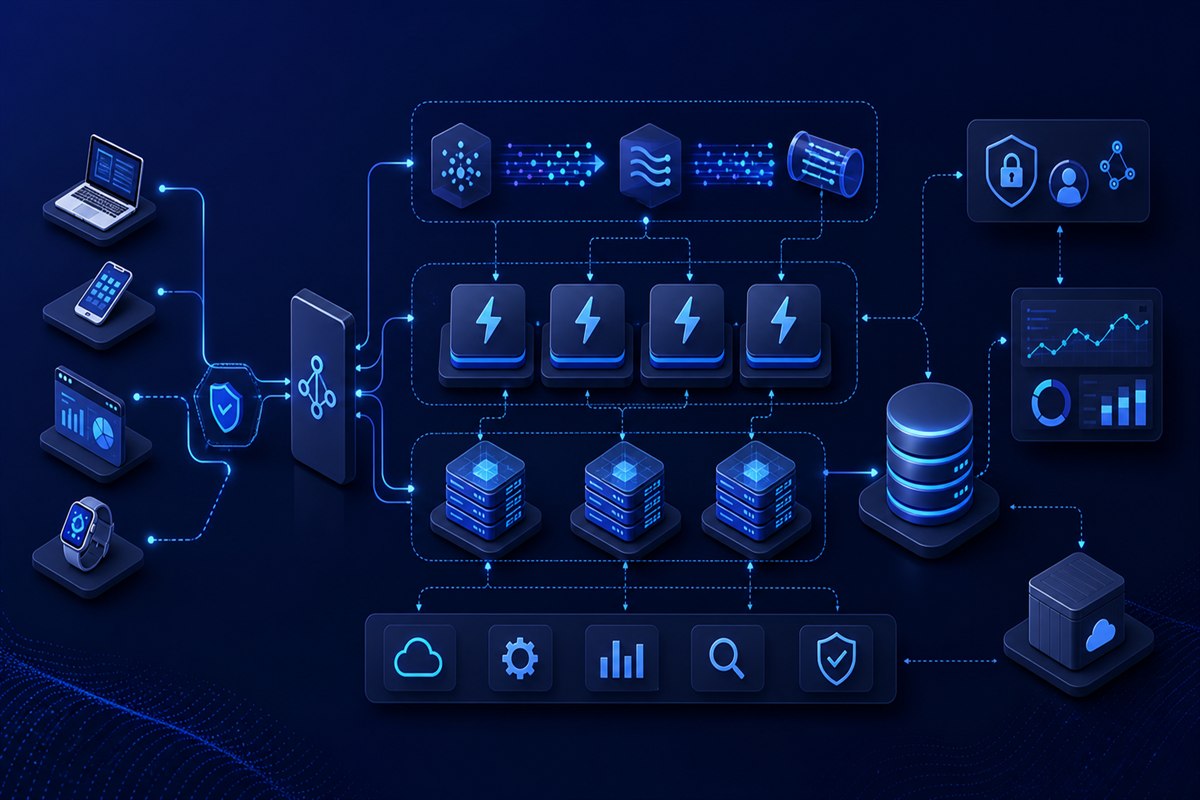
Cloud application development services for real operations
Cloud architecture should reflect traffic patterns, recovery expectations, data sensitivity and the skills of the team that will run it. We assess those factors before selecting managed, container or serverless components. A modest internal application may need a straightforward deployment model, while a customer-facing platform may justify asynchronous processing, elastic services and stronger isolation.
For migration work, we identify application dependencies, data movement, identity, scheduled tasks and external integrations before choosing a strategy. Some workloads benefit from re-platforming; others should be modernized gradually behind stable interfaces. The plan includes monitoring and rollback so production behaviour can be understood during transition.
cloud application development services: problems we solve
- Infrastructure cannot respond predictably to changing demand.
- Releases depend on manual configuration and specialist knowledge.
- An application has hidden dependencies that complicate migration.
- Logs and metrics do not explain production failures.
- Cloud services have grown without ownership or cost controls.
- Security boundaries differ between environments and teams.
cloud application development services: core capabilities
Cloud-native application design
We define application boundaries, data flows, availability needs and deployment units before selecting services. The architecture supports expected change and gives operators clear responsibility for each component.
Serverless workflows
AWS Lambda and API Gateway can support event-driven APIs, automation and variable workloads. We plan retries, timeouts, idempotency and observability so serverless behaviour remains understandable under failure.
Migration and re-platforming
Application inventories, dependency maps and data classification inform the migration sequence. Compatibility, cutover and rollback are tested rather than assumed, reducing disruption to connected business processes.
Cloud integration and operations
Secure APIs, queues and scheduled processing connect cloud services with existing systems. Dashboards, alerts, structured logs and runbooks help support teams respond to evidence instead of guessing.
Technology used for cloud application development services
Solutions may use ASP.NET Core services, React interfaces, PostgreSQL or SQL Server, Docker containers and AWS managed services. Lambda, API Gateway, S3, DynamoDB and event services are considered when their operational characteristics suit the workload. We avoid adding services solely because they are fashionable.
Identity and least-privilege access are designed across application and infrastructure layers. Secrets remain outside source code, environments are reproducible, and production telemetry covers customer-facing paths. Capacity, backup and recovery decisions are documented with the assumptions behind them.
Our cloud application development services approach also draws on the AWS Well-Architected Framework as a relevant external reference.
cloud application development services: our delivery process
Workload assessment
Review demand, dependencies, data and service expectations.
Target design
Define boundaries, resilience and responsibility.
Security planning
Map identity, secrets, network and data controls.
Migration sequencing
Prioritize low-risk learning before critical cutovers.
Application delivery
Build cloud-ready features in testable increments.
Resilience testing
Exercise retries, failures, limits and recovery paths.
Release control
Automate deployment and verify observability.
Operational improvement
Use production evidence to refine reliability and cost.
cloud application development services: engagement options
A defined cloud project can deliver a new workload, migration wave or serverless integration. A dedicated team is appropriate when application and platform roadmaps move together over several releases. Existing technology teams can use targeted staff augmentation for AWS architecture, .NET services, React interfaces or deployment automation.
Consultation may cover a cloud-readiness review, architecture challenge or modernization roadmap before implementation. Maintenance arrangements include application incidents, dependency changes, monitoring refinement and controlled enhancements, with responsibilities agreed between business, engineering and infrastructure stakeholders.
Cloud applications across operational domains
We support cloud solutions for SaaS administration, booking and scheduling, customer-support automation, secure business workflows and reporting. These domains benefit from scalable APIs and managed infrastructure, but they also require careful treatment of permissions, availability, integration failures and data ownership.
Why work with Pentatomic Solutions on AWS
- Application and infrastructure decisions considered together
- Experience with .NET, React, APIs and serverless AWS services
- Migration plans that account for dependencies and business continuity
- Security, monitoring and recovery designed before production release
- Clear technical communication with international stakeholders
- No implication of certifications or official partnerships that are not verified
cloud application development services: frequently asked questions
Should every application be rebuilt as serverless?
No. Serverless is useful for suitable traffic and event patterns, but containers or conventional managed hosting may be simpler for steady workloads or existing operational skills. We choose after examining the application.
Can you migrate an application while users continue working?
Often, yes. The approach may use staged data movement, parallel operation, compatibility interfaces and a controlled cutover. The acceptable interruption and rollback point are agreed for each workload.
How do you prevent unexpected AWS costs?
Architecture decisions include demand assumptions, retention, data transfer and operational ownership. Monitoring and budgets provide visibility, while production evidence identifies services that should be resized or redesigned.
Can cloud services integrate with an on-premises system?
Yes. We design secure API or messaging connections based on network constraints, data sensitivity, latency and failure behaviour. Integration responsibility and reconciliation are documented.
What operational documentation is provided?
Documentation can include architecture decisions, environment configuration, deployment guidance, dashboards, alert interpretation, backup and recovery procedures, and runbooks for important failure scenarios.