
PENTATOMIC SOLUTIONS · SERVICES
Web Application Development
web application development services — Our web application development services create responsive portals and business platforms for users who need to complete meaningful work in a browser. Pentatomic Solutions combines clear interaction design with secure APIs and maintainable application architecture.
We develop new systems, modernize ageing interfaces and integrate web applications with the data and services that already support your organisation.
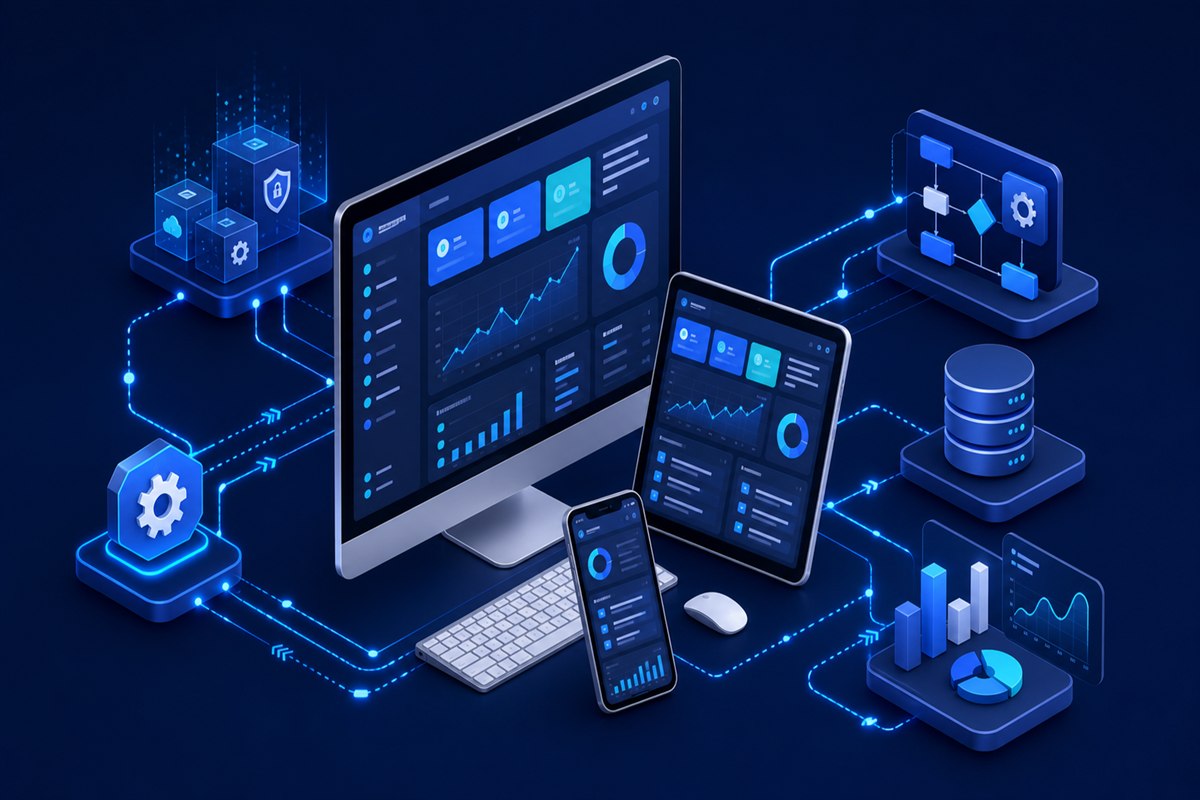
Web application development services organized around users
A business web application should help customers, staff or partners complete a process with confidence. We study the decisions, information and exceptions within each journey before defining screens. This avoids interfaces that look polished but expose internal system complexity or leave users uncertain about the next action.
Behind the interface, APIs enforce business rules and protect data. We separate presentation concerns from application logic so channels can evolve without duplicating rules. Accessibility, responsive behaviour, validation and useful error states are considered during design rather than deferred until the end of development.
web application development services: problems we solve
- Users repeat information because systems are not connected.
- Complex forms fail without clear guidance or recovery.
- Legacy interfaces work poorly on modern devices.
- Business rules are duplicated across screens and services.
- Partners need controlled self-service access to shared processes.
- Reporting views do not support operational decisions.
web application development services: core capabilities
Customer and partner portals
Secure portals support onboarding, booking, document exchange, account management and service requests. Journeys are designed for infrequent users as well as the staff who handle exceptions.
Operational web applications
We build dashboards, administration tools, scheduling interfaces and workflow systems for high-frequency business use. Navigation and data presentation reflect role, urgency and decision context.
React interface development
React and TypeScript enable reusable, testable interfaces for complex interaction. State management and component design remain proportionate to the application instead of adding unnecessary front-end machinery.
APIs and third-party services
Web applications can integrate identity, payment, communication, CRM and specialist platforms through secure APIs. Timeouts, validation and partial failure receive visible, supportable handling.
Technology used for web application development services
React and TypeScript support interactive interfaces, while ASP.NET Core and C# provide APIs and business services. PostgreSQL or SQL Server can store transactional data, and AWS hosting offers deployment choices for appropriate workloads. The stack is adjusted to existing technology and support capability.
Performance work covers payload size, rendering, caching and database access rather than focusing on one layer. Authentication and authorization protect both screens and API operations. Semantic HTML, keyboard interaction and readable feedback improve accessibility for users with different devices and needs.
Our web application development services approach also draws on the MDN web accessibility guidance as a relevant external reference.
web application development services: our delivery process
Journey discovery
Observe tasks, decisions, delays and exception handling.
Information design
Organize content and actions around user intent.
Interface prototypes
Validate complex flows before implementation.
API architecture
Define rules, contracts, permissions and data access.
Vertical delivery
Build complete journeys across interface and services.
Usability assurance
Test devices, accessibility, validation and recovery.
Production release
Deploy with analytics, monitoring and support preparation.
Experience refinement
Use evidence and feedback to prioritize improvements.
web application development services: engagement options
A fixed-scope engagement can deliver a portal, workflow or defined modernization milestone. A dedicated team is suitable for a web product with an active roadmap and regular user feedback. Staff augmentation can add React, TypeScript, .NET or quality-engineering capability within an established product group.
Consultation can evaluate accessibility, architecture, user journeys or a difficult integration before implementation. For live platforms, maintenance and enhancement combines defect support, browser and dependency changes, performance work and planned feature releases.
Web applications for process-heavy domains
We understand booking and reservation journeys, hospitality administration, space and resource allocation, insurance workflows, healthcare technology and sports or event operations. These systems often require responsive self-service alongside detailed internal controls and reliable integration.
Why select Pentatomic Solutions for web delivery
- Business-process analysis before interface implementation
- React, TypeScript, ASP.NET Core and API expertise
- Responsive and accessible interaction considered throughout delivery
- Clear handling of permissions, validation and integration failures
- Reviewable end-to-end increments rather than disconnected layers
- Ongoing support for evolving browser-based products
web application development services: frequently asked questions
What is the difference between a website and a web application?
A website primarily presents content, while a web application supports authenticated tasks, business rules, data entry and system interaction. Some platforms combine both, but application delivery requires deeper workflow and security design.
Can you improve an existing React application?
Yes. We assess component structure, state management, accessibility, performance, API usage and testing. Improvements can be targeted around risky journeys instead of requiring an immediate front-end rewrite.
How do you test responsive behaviour?
Important journeys are checked across agreed screen sizes, input methods and browsers. We also test content expansion, validation, keyboard navigation and error states that often expose layout problems.
Can the application use our current identity provider?
Often it can. We review the provider, protocols, role model and logout or session requirements, then design authorization separately from sign-in so application permissions remain explicit.
Do you provide accessibility support?
We use semantic structure, keyboard-accessible controls, visible focus, labels and appropriate contrast as part of implementation. Specific conformance testing can be scoped according to your required standard and audience.