Planning a migration from legacy PBX to Amazon Connect often stalls inside enterprise IT departments. Technical leaders fear call drops, carrier blackouts, and operational disruption.
Six-figure maintenance contracts and rigid hardware make legacy systems a costly burden. In addition, waiting months for simple IVR changes severely limits engineering velocity. However, the prospect of a chaotic cutover weekend keeps organizations tethered to legacy data centers.
At Pentatomic Solutions, we treat modernizing from legacy PBX to Amazon Connect as a distributed systems challenge. We do not use risky lift-and-shift methods. Instead, our team applies an engineered, four-phase blueprint. This approach ensures zero downtime, guaranteed rollback safety, and continuous agent productivity.
Why Traditional Big-Bang Telephony Cutover Fails
Most failed voice migrations attempt a single weekend cutover. Teams point telecom carriers to new endpoints, roll out unfamiliar agent desktops, and hope for stability. Consequently, this rushed approach triggers three critical failure modes:
- Carrier Porting Latency & Blackouts: Toll-free number porting across telecom carriers rarely happens synchronously. As a result, out-of-sync routing generates intermittent 503 errors for incoming callers.
- Context Inversion Across Departments: If tier-1 support moves to the cloud while tier-2 remains on-premise, transfers break. Therefore, callers must repeat their account information multiple times.
- Agent Desktop Cognitive Overload: Forcing call center agents into a new interface overnight spikes Average Handle Time. In addition, this friction increases agent turnover and caller frustration.
Therefore, successful teams avoid big-bang cutovers. Instead, they implement an engineered hybrid coexistence architecture.
The 4-Phase Migration from Legacy PBX to Amazon Connect
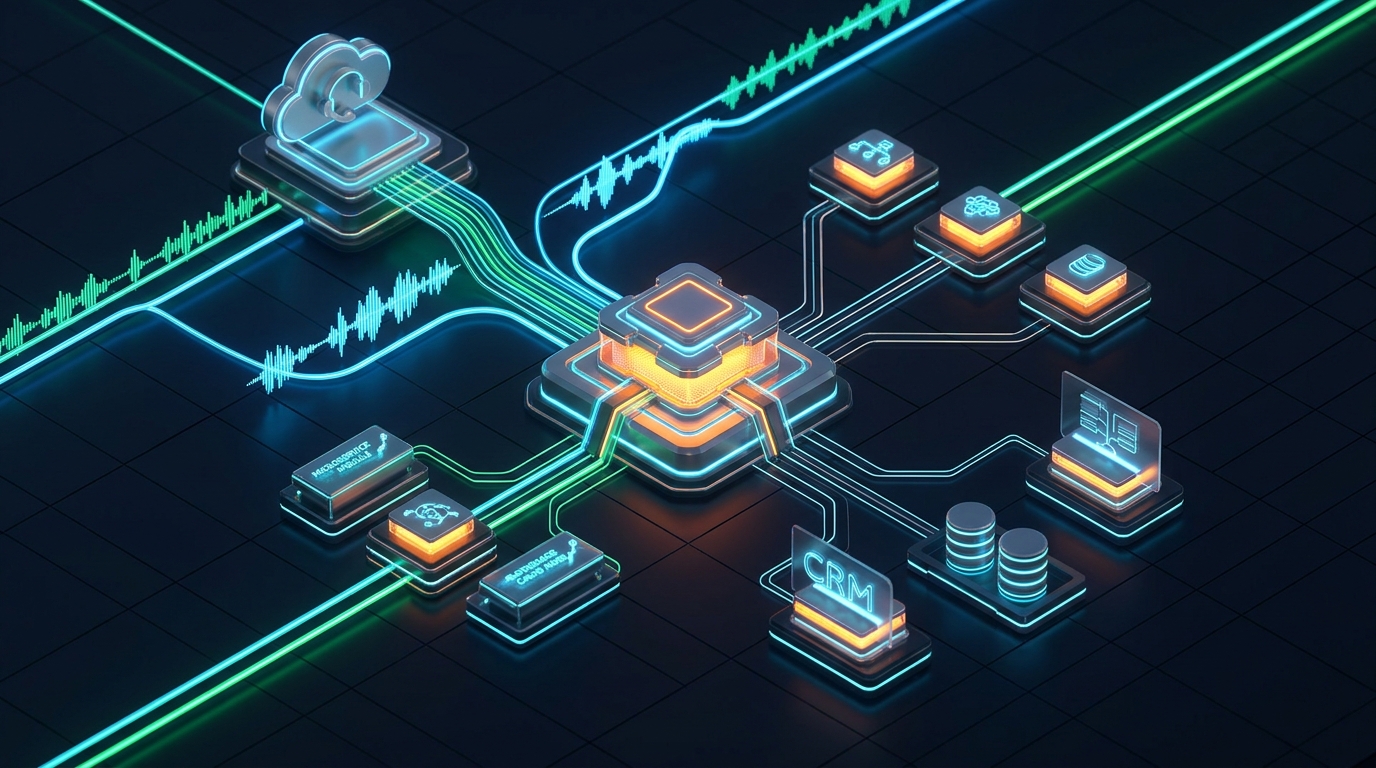
Inbound PSTN / Carrier → SBC / Amazon Chime SDK Voice Connector → Weighted SIP Trunk (Amazon Connect) & Direct SIP (Legacy PBX) → AWS Lambda & DynamoDB Shared State
Phase 1: Hybrid SIP Trunking & Split-Routing
First, we deploy an upstream Session Border Controller or Amazon Chime SDK Voice Connector. Rather than porting carrier numbers immediately, we split inbound calls using weighted SIP targets. For example, we direct 5% of incoming calls to Amazon Connect, while 95% remain on the legacy PBX. Furthermore, this provides instant 60-second rollback safety.
Phase 2: CRM & Contact State Synchronization
Second, we eliminate blind transfers between cloud and on-premise agents. We deploy a real-time synchronization layer using AWS Lambda and Amazon DynamoDB. When a call enters Amazon Connect, a sub-second query retrieves caller context and open support tickets. In addition, our guide on optimizing Amazon Connect contact flows details how to prevent IVR latency during this step.
Phase 3: Pilot Queue Validation
Third, we validate system health on low-risk, high-volume queues such as order status checks. During this phase, engineering teams monitor audio MOS scores and WebRTC network stability under live traffic. Additionally, teams configure deflection flows using Amazon Lex bots.
Phase 4: Full Cutover & Legacy Decommissioning
Finally, we migrate all remaining departmental queues in planned, incremental sprints. Once all call volume handles smoothly on Amazon Connect, carriers execute final toll-free number porting. After carrier confirmation, teams safely decommission the legacy PBX hardware.
Modernize Your Voice Infrastructure with Confidence
Pentatomic Solutions designs, builds, and maintains enterprise cloud contact centers. Explore our comprehensive Amazon Connect consulting services or learn more about official AWS telephony architecture options.
Ready to migrate from legacy PBX to Amazon Connect without downtime? Schedule a technical architecture review with our team at pentatomicsolutions.in.